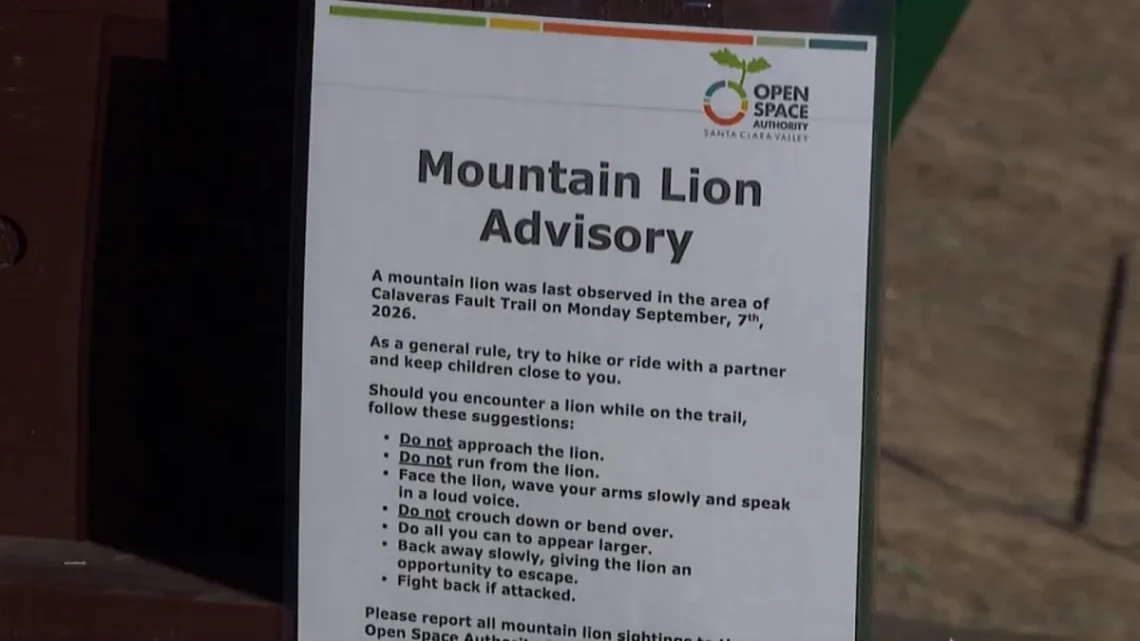
SAN JOSE, CA — Hikers at Sierra Vista Open Space Preserve are now meeting a warning before they even start down the trail: a mountain lion was reported near the Calaveras Fault Trail. The advisory comes after a nearby hiker said she encountered a mountain lion on another trail and was airlifted to safety, though she was not injured.
Wildlife experts say the recent sightings are a reminder that Bay Area trails can overlap with mountain lion habitat. Biologists advise visitors to be especially cautious in the evening, when hiking alone can increase the chance of an encounter. The guidance is simple: know the risk, stay alert and avoid giving a large cat a reason to feel cornered.
A trail warning greets hikers at Sierra Vista Open Space Preserve
The warning signs at Sierra Vista spell out what to do if someone comes face-to-face with a mountain lion. For some hikers, including a recent transplant from Tennessee named Will, the alert was enough to make the experience feel a little different, but not enough to cancel the outing.
He said he noticed the warning, thought it over and kept hiking anyway, while hoping he would not see one of the big cats. The preserve is among the places where the public is being reminded that mountain lions move through open space and foothill corridors. Officials and wildlife advocates say that does not mean attacks are likely, but it does mean visitors should pay attention to posted advice.
Experts emphasize that the animals are part of the landscape in these areas. A sighting does not automatically mean aggression, but it does reinforce the need for people to avoid wandering in isolated conditions without a plan for what to do if a cat appears.
Recent trail encounter led to an airlift but no injuries
The warning signs were posted after a hiker on a nearby trail reported encountering a mountain lion and required an airlift to safety. Authorities said she was not hurt, and experts described the encounter as not aggressive behavior.
Even so, the incident served as a reminder that the South Bay’s open spaces are active wildlife habitat. Zara McDonald, a biologist with the Bay Area Puma Project, said people are better off avoiding solo hikes at dusk or later in the day. She added that trails known to be used by mountain lions are not the best place to be after dark.
The advice is aimed at reducing the odds of a close encounter rather than suggesting that mountain lions are seeking out people. Experts say the animals generally want nothing to do with hikers and usually move away when given room.
Why a mountain lion in San Francisco drew a larger response
Seeing a mountain lion on a foothill trail is one thing. Spotting one in the middle of San Francisco is much less common. Over the weekend, a mountain lion was seen in a tree near Fell and Baker streets in the Panhandle neighborhood, prompting a joint response from police, animal control and wildlife officials.
A park ranger confirmed the animal had been seen, which led city agencies to coordinate their response. By Sunday, officials said the mountain lion had left the area on its own. The sighting was unusual enough to draw attention, but it ended without anyone being hurt and without the animal being captured.
McDonald said such urban sightings are rare, though not impossible. She noted that mountain lions from the Santa Cruz Mountains sometimes move into the city as they travel through the region.
Fragmented habitat is pushing some cats through urban neighborhoods
Wildlife experts say the Bay Area’s changing landscape helps explain why mountain lions occasionally appear in neighborhoods. As habitat becomes more fragmented around the region and across California, cats may be forced to travel through urban areas simply to move from one stretch of habitat to another.
McDonald, who directs the Bay Area Puma Project, said that sometimes those animals can get stuck once they enter developed areas. She pointed to a mountain lion that wandered through San Francisco’s Pacific Heights neighborhood in January before it was captured and returned to the wild.
The broader message, experts say, is that people should not assume a cat in town is behaving aggressively. In many cases, it is just trying to find a way through human-dominated space and back to more suitable habitat.
What to do if a mountain lion appears nearby
McDonald said the best response is to give the animal an escape route and avoid actions that could make the encounter worse. People should not approach a mountain lion, run from it or turn their backs to it.
If the animal comes toward you, she said, the right move is to make yourself look larger, make noise and avoid turning away. If children are nearby, pick them up. Wildlife experts say those steps help signal that the person is not prey and may encourage the cat to move on.
Officials stress that the safest approach is awareness. Whether someone is walking in the foothills or in a city neighborhood, knowing that mountain lions may be present is often the best protection.