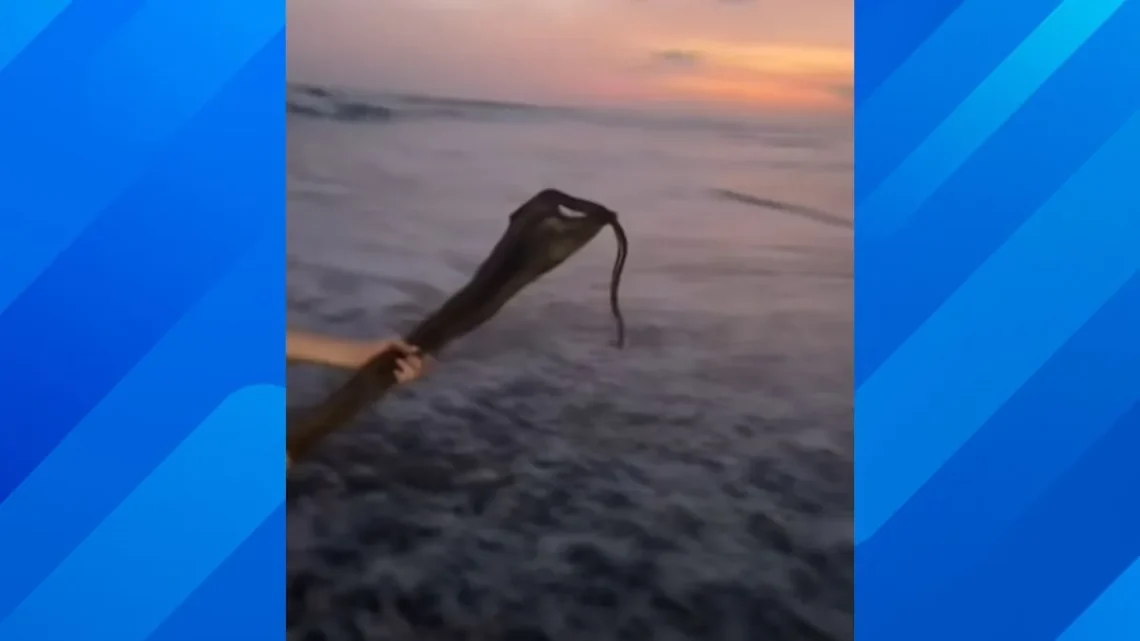
LOS ANGELES, CA — A family visiting Crystal Cove State Beach in Southern California came across what looked like a sluggish snake on the sand and tried to help it get back into the water. Jackie Aguilar later told CBS News Los Angeles that she used a long palm frond to move the reptile, believing it was simply struggling near shore.
Only afterward did she learn the animal may have been a yellow-bellied sea snake, a species described by the Australian Museum as highly toxic. Aguilar said she initially assumed the snake was harmless, then researched it after others warned her that it could be one of the more poisonous kinds of snakes. No one was injured during the encounter.
How a beach rescue turned into a close call
Aguilar’s cellphone footage shows the moment she lifted the snake with the palm frond and guided it toward the surf. The family believed the animal had likely washed up from the ocean and was in distress, so their instinct was to help it rather than leave it on the beach.
That response is understandable, but marine wildlife experts say it can be risky when people are unable to identify a snake or animal with confidence. The family made it through the incident safely, but the episode is a reminder that stranded sea life should be treated with caution, especially when a creature appears weak, unfamiliar, or difficult to classify from a distance.
Why yellow-bellied sea snakes draw attention in Southern California
Yellow-bellied sea snakes are not common visitors to Southern California beaches. In 2015, Scientific American reported two washups in the region, and Greg Pauly, assistant curator of herpetology at the Natural History Museum of Los Angeles, said that north of the tip of Baja California there had been only five documented observations of the snake at that point.
Pauly said that before that year, the record included only three documented observations in the area. That rarity is part of why a snake like this can surprise beachgoers who do not expect to see a tropical sea snake on a California shoreline.
Warmer ocean conditions can push tropical species ashore
Pauly linked the unusual arrival of the snakes to warmer water associated with El Niño. The changing conditions can alter ocean currents and temperatures enough to bring subtropical and tropical species closer to California beaches, including yellow-bellied sea snakes.
UC San Diego’s Scripps Institution of Oceanography says El Niño has broad effects on the ocean ecosystem. Beyond shifting where species appear, it can also affect ocean chemistry, including pH. Experts have said a strong El Niño year can mean more surprises for beachgoers as marine life moves outside its usual range.
How Aguilar identified the snake after the fact
Aguilar told CBS News Los Angeles that she did not know what type of snake she had handled until people urged her to look it up. After doing her own research, she connected the reptile to the yellow-bellied sea snake, which is known for its yellow underside and flat tail.
Those markings help distinguish it from land snakes or other sea creatures that might wash ashore. Still, the family had only a brief encounter in real time, and their decision was based on the snake’s behavior, not on a detailed identification. By the time they learned more, the snake was already back in the water.
What beachgoers should remember when wildlife looks stranded
The Crystal Cove encounter shows how quickly a routine day at the beach can turn into a wildlife safety issue. Even when an animal appears harmless or exhausted, people should be careful about touching, moving, or returning it to the ocean without knowing exactly what it is.
Experts cited in coverage of the species have emphasized that yellow-bellied sea snakes become a concern when they drift ashore. For beachgoers, the safest approach is to keep a distance, avoid direct contact, and alert the appropriate local authorities or lifeguards if a stranded animal appears dangerous or unfamiliar.
A rare encounter that ended without injury
Despite the close call, the family’s encounter ended without anyone being bitten or harmed. Aguilar’s story has drawn attention because it combines a rare animal sighting with a moment many parents or beach visitors might recognize: the impulse to help what looks like a helpless creature.
That instinct, however, can carry risk when venomous sea snakes are involved. The Crystal Cove case offers a simple lesson for coastal visitors: when an animal on the beach is unfamiliar, leave the handling to trained professionals whenever possible.